

Selecting the right refractory materials for hard aluminum alloy melting furnaces is essential for stable furnace operation, aluminum melt quality, energy efficiency, and long service life. Different furnace areas are exposed to different temperatures, mechanical loads, thermal cycling, and chemical conditions. Therefore, using one refractory material throughout the entire furnace is usually not the most effective approach.
A hard aluminum alloy melting furnace requires a carefully designed refractory lining system. The furnace roof, upper wall, furnace bottom, lower wall, furnace door, and door frame each require materials with different performance characteristics. Heavy-duty castables, lightweight insulating castables, aluminum-non-wetting castables, anti-penetration castables, high-strength wear-resistant castables, and steel-fiber self-flowing castables can work together to form a functional multilayer lining.

Why Refractory Selection Matters in Aluminum Alloy Melting Furnaces
Aluminum alloys have particular requirements for refractory linings. The working lining may come into direct contact with molten aluminum, while other areas are mainly exposed to high-temperature gases, thermal radiation, mechanical impact, or repeated heating and cooling.
If the refractory lining is not properly selected, several problems can occur. Molten aluminum may penetrate into pores and cracks, refractory materials may become difficult to clean, and repeated thermal cycling can accelerate cracking and spalling. Excessive heat loss through the furnace wall can also increase energy consumption.
For these reasons, the selection of refractory materials for hard aluminum alloy melting furnaces should consider the actual operating environment of each furnace section rather than focusing only on maximum temperature resistance.
Refractory Materials for the Furnace Roof
The furnace roof is continuously exposed to high-temperature furnace gases and thermal radiation. It must maintain its structural stability while limiting heat transfer to the outside environment.
Heavy-duty castable is suitable for areas where higher structural strength and temperature resistance are required. It can provide a strong hot-face or structural layer and withstand repeated thermal exposure.
Lightweight insulating castable can be installed as an insulation layer behind the dense refractory lining. Its lower thermal conductivity helps reduce heat loss and maintain the required furnace temperature.
The combination of heavy-duty castable and lightweight insulating castable allows the roof to balance structural strength with thermal insulation. The exact thickness and material combination should be determined according to furnace design, operating temperature, roof construction, and installation method.
Refractory Materials for the Upper Furnace Wall
The upper furnace wall is generally exposed to high-temperature gases and radiation rather than continuous direct contact with molten aluminum. However, it still needs sufficient resistance to thermal cycling, mechanical stress, and high-temperature degradation.
Heavy-duty castable can be used as the dense refractory layer. Its strength and resistance to thermal exposure help maintain the integrity of the furnace wall.
A lightweight insulating castable can be positioned behind the working or dense layer. This insulation reduces heat transfer through the furnace shell and supports more efficient furnace operation.
For industrial furnace construction, the combination of dense and insulating layers is important because simply increasing the thickness of a dense refractory material may not provide the same insulation performance as a properly designed composite lining.
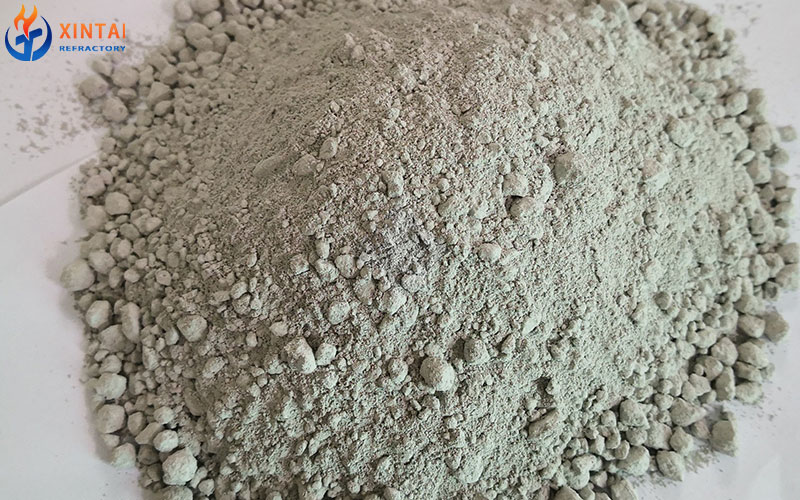
Furnace Bottom and Lower Wall: The Critical Aluminum-Contact Area
The furnace bottom and lower wall are among the most demanding areas when selecting refractory materials for hard aluminum alloy melting furnaces. These sections can be exposed directly to molten aluminum, making resistance to aluminum penetration and adhesion particularly important.
Aluminum-non-wetting castable is recommended as a working-layer material in areas that contact molten aluminum. Its purpose is to reduce the tendency of molten aluminum to wet and penetrate the refractory surface. This can help protect the lining and make furnace cleaning and maintenance easier.
Anti-penetration castable can be used as an additional protective layer beneath the working lining. Its function is to reduce the possibility of molten metal penetrating deeper into the furnace structure.
A lightweight insulating castable can then be installed behind the protective layers to reduce heat loss.
This multilayer structure provides different functions: the aluminum-non-wetting layer faces the molten metal, the anti-penetration layer provides additional protection, and the lightweight insulating layer helps maintain thermal efficiency. Material compatibility and layer thickness should be determined based on furnace construction and actual operating conditions.
Refractory Materials for the Furnace Door
The furnace door experiences repeated opening and closing, thermal cycling, and direct exposure to high-temperature gases. Compared with a fixed wall, it may also experience greater mechanical vibration and impact during operation.
Lightweight insulating castable is useful where reducing the weight of the door and limiting heat transfer are important. Its low density and insulation properties can help reduce thermal losses.
However, areas subject to greater mechanical wear require additional strength. High-strength wear-resistant castable can therefore be used in suitable sections of the furnace door where resistance to abrasion, impact, and repeated operation is required.
The final design should balance insulation, mechanical strength, thermal shock resistance, and door weight.
Furnace Door Frame and Surrounding Areas
The furnace door frame and surrounding sections require a refractory material that can tolerate repeated thermal cycling, mechanical impact, and localized stress.
Steel-fiber self-flowing high-temperature high-strength castable is suitable for applications where high strength and good installation performance are required. Steel fibers can improve the mechanical reinforcement of the castable, while the self-flowing characteristic can help the material fill complex sections during installation when the construction conditions are appropriate.
This type of castable can be considered for areas around the door frame that experience frequent mechanical and thermal stress. Proper mixing, casting, curing, and dry-out procedures remain essential for achieving the designed performance.
How to Build a Suitable Refractory Lining System
A reliable lining system should not be based on temperature resistance alone. Buyers and furnace manufacturers should evaluate several factors before selecting refractory materials for hard aluminum alloy melting furnaces.
First, identify whether each section directly contacts molten aluminum. Aluminum-contact areas require different protection from areas exposed mainly to furnace atmosphere.
Second, consider thermal conductivity. The dense working layer provides protection, while lightweight insulation can reduce heat loss behind the working layer.
Third, evaluate thermal cycling. Furnaces that experience frequent start-up, shutdown, and temperature changes require materials with suitable thermal shock resistance and dimensional stability.
Fourth, consider mechanical conditions. Furnace doors and door frames may experience more impact and abrasion than stationary sections.
Finally, construction quality must be considered together with material selection. Incorrect water addition, insufficient mixing, poor curing, improper dry-out, or unsuitable layer thickness can reduce the service performance of even a high-quality refractory castable.
Recommended Refractory Structure by Furnace Area
For a hard aluminum alloy melting furnace, a practical material arrangement can be summarized as follows:
- Furnace roof: heavy-duty castable + lightweight insulating castable
- Upper furnace wall: heavy-duty castable + lightweight insulating castable
- Furnace bottom and lower wall: aluminum-non-wetting castable + anti-penetration castable + lightweight insulating castable
- Furnace door: lightweight insulating castable + high-strength wear-resistant castable
- Door frame and surrounding areas: steel-fiber self-flowing high-temperature high-strength castable
This area-specific approach allows each refractory layer to perform the function it is designed for rather than requiring a single material to satisfy every operating condition.
Conclusion
The performance of a hard aluminum alloy melting furnace depends not only on furnace design and heating equipment but also on the quality and configuration of its refractory lining. Choosing suitable refractory materials for hard aluminum alloy melting furnaces requires an understanding of temperature, molten aluminum contact, thermal cycling, mechanical stress, heat loss, and construction requirements.
Heavy-duty castables are suitable for structural high-temperature areas, while lightweight insulating castables help reduce heat loss. Aluminum-non-wetting castables are particularly important for molten-aluminum contact zones, supported by anti-penetration layers and insulation. Furnace doors can combine lightweight insulating and high-strength wear-resistant castables, while steel-fiber self-flowing high-temperature high-strength castables can provide reinforcement around demanding door-frame areas.
For furnace builders, aluminum alloy producers, foundries, and industrial refractory buyers, a customized multilayer lining design can provide a more practical solution than selecting refractory materials solely according to a nominal temperature rating.