
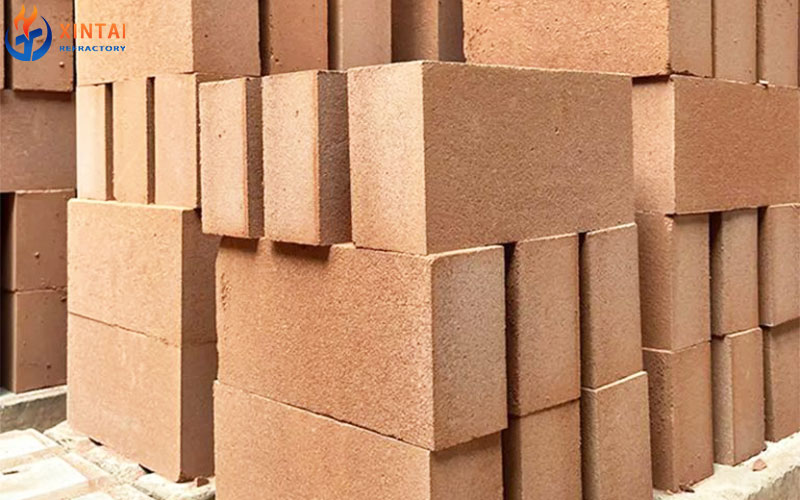
Fireclay bricks are among the most widely used refractory materials in industrial furnace linings due to their stable thermal performance, cost efficiency, and broad application range. However, not all fireclay bricks are the same. In industrial engineering practice, a clear distinction is made between standard (ordinary) fireclay bricks and dense fireclay bricks.
Although both belong to the aluminosilicate refractory family, they differ significantly in bulk density, porosity, mechanical strength, corrosion resistance, and service environments. Understanding these differences is critical for selecting the right material for kilns, furnaces, and high-temperature industrial systems.
This article provides a detailed technical comparison from composition to performance and application.
1. Material Composition and Raw Material System
Ordinary Fireclay Bricks
Ordinary fireclay bricks are produced using a mixture of:
- Refractory clay (kaolin-based materials)
- Semi-refractory clay or chamotte (grog)
- Minor additives for plasticity and shaping
Typical characteristics:
- Al₂O₃ content: approximately 40%–55%
- Balanced silica-alumina matrix
- Standard-grade grog content
The structure is relatively porous due to conventional sintering and limited densification of the matrix.
Dense Fireclay Bricks
Dense fireclay bricks use a more refined raw material system:
- High-quality refractory clay
- Increased proportion of fused chamotte / clinker (often including high-grade bauxite or flint clay such as calcined flint materials)
- Optimized particle grading for tighter packing
Key differences:
- Improved particle distribution
- Higher sintering density
- Reduced micro-porosity in the final structure
The inclusion of high-density aggregates is the primary reason for improved mechanical and chemical resistance.

2. Bulk Density and Apparent Porosity
One of the most critical distinguishing parameters is porosity, which directly affects thermal insulation, strength, and resistance to slag penetration.
Ordinary Fireclay Bricks
- Bulk density: 2.10–2.15 g/cm³
- Apparent porosity: ~26%
The relatively high porosity means:
- Better thermal insulation
- Lower thermal conductivity
- Reduced mechanical strength
- Higher permeability to molten slag and gases
Dense Fireclay Bricks
- Bulk density: ≥ 2.20 g/cm³
- Apparent porosity: < 18% (can be lower depending on grade)
Implications of lower porosity:
- Stronger resistance to chemical attack
- Improved abrasion resistance
- Higher mechanical load-bearing capacity
- Better structural stability under long-term thermal stress
In advanced grades, ultra-dense fireclay bricks may reach porosity levels below 12%, making them suitable for severe industrial conditions.
3. Manufacturing Process Differences
Although both types follow similar forming methods (pressing, extrusion, or slip casting), their firing regimes differ.
Ordinary Fireclay Brick Production
- Sintering temperature: 1360–1380°C
- Standard kiln firing curve
- Moderate shrinkage control
The result is a stable but relatively open microstructure.
Dense Fireclay Brick Production
- Sintering temperature: approximately +30°C higher than standard bricks
- Longer soaking time at peak temperature
- Enhanced vitrification and particle bonding
During firing:
- Controlled shrinkage occurs
- Pore structure becomes compacted
- Bulk density increases naturally
This densification process is critical for improving performance in aggressive environments.
4. Mechanical Strength and Thermal Performance
Strength Comparison
| Property | Ordinary Fireclay Brick | Dense Fireclay Brick |
|---|---|---|
| Compressive Strength | Moderate | High |
| Hardness | Medium | High |
| Wear Resistance | Standard | Excellent |
Dense fireclay bricks exhibit significantly higher structural integrity, especially under mechanical abrasion and load-bearing conditions.
Thermal Behavior
Ordinary Fireclay Bricks
- Better thermal shock resistance
- Suitable for intermittent heating cycles
- More tolerant of rapid temperature changes due to higher porosity
Dense Fireclay Bricks
- Higher refractoriness under load
- Better high-temperature stability
- Superior resistance to deformation
- Slightly lower thermal shock resistance compared to porous bricks
This trade-off is important: increased density improves strength but reduces thermal shock tolerance.
5. Corrosion and Slag Resistance
Ordinary Fireclay Bricks
- Moderate resistance to acidic slag
- More vulnerable to penetration due to higher porosity
- Suitable for less aggressive chemical environments
Dense Fireclay Bricks
- Strong resistance to:
- Molten slag infiltration
- Alkali vapor attack
- Metal vapor corrosion
- Reduced pore channels prevent deep penetration of corrosive media
This makes dense fireclay bricks ideal for chemically aggressive furnace zones.
6. Color and Microstructural Characteristics
Visual and microstructural differences are also noticeable:
Ordinary Fireclay Bricks
- Color: light yellow to pale beige
- Uniform internal structure
- Cross-section matches surface texture
Dense Fireclay Bricks
- Color: deeper red or reddish-brown
- Visible inclusion of coarse aggregate particles
- Cross-section shows:
- White or light-colored refractory aggregate grains
- Dense matrix bonding structure
- More complex fracture network patterns
The internal structure of dense bricks contributes to their higher crack resistance and spalling resistance.
7. Application Areas in Industrial Furnaces
Ordinary Fireclay Bricks – Typical Applications
Due to good thermal insulation and cost efficiency, they are widely used in:
- Industrial kilns below 1250°C
- Iron alloy furnaces
- Aluminum smelting furnaces
- Heat treatment furnaces with moderate conditions
They are preferred where:
- Thermal cycling is frequent
- Chemical attack is limited
- Cost optimization is important
Dense Fireclay Bricks – Typical Applications
Dense bricks are designed for harsher environments such as:
- Glass furnace linings
- Blast furnace auxiliary zones
- Hot blast stoves
- Heating furnaces with high abrasion conditions
- Non-ferrous metal refining furnaces
- Rotary kiln transition zones
In particular, low-porosity grades (<12%) are used in:
- Severe chemical corrosion environments
- High-temperature rotating systems
- High-wear industrial zones
8. Performance Trade-Off Analysis
When selecting between these two materials, engineers must consider key trade-offs:
Advantages of Ordinary Fireclay Bricks
- Better thermal shock resistance
- Lower cost
- Easier replacement and maintenance
- Suitable for cyclic heating systems
Disadvantages
- Lower mechanical strength
- Higher wear rate
- Limited corrosion resistance
Advantages of Dense Fireclay Bricks
- High compressive strength
- Excellent wear resistance
- Strong slag and chemical resistance
- Long service life in harsh environments
Disadvantages
- Higher production cost
- Slightly reduced thermal shock resistance
- Heavier weight due to increased density
9. Selection Guidelines for Engineering Applications
To choose the correct brick type, engineers typically evaluate:
Operating Temperature
- Below 1250°C → Ordinary fireclay bricks are sufficient
- Above 1300°C → Dense fireclay bricks recommended
Chemical Environment
- Weak corrosion → Ordinary bricks
- Strong slag or alkali attack → Dense bricks
Mechanical Load
- Light to moderate → Ordinary bricks
- Heavy load / abrasion → Dense bricks
Thermal Cycling Frequency
- Frequent cycling → Ordinary bricks preferred
- Stable continuous operation → Dense bricks preferred
Conclusion: Optimizing Refractory Performance Through Material Selection
The difference between dense fireclay bricks and ordinary fireclay bricks is fundamentally defined by porosity control and structural densification. While both materials share a similar chemical foundation, their performance diverges significantly due to differences in bulk density, firing technology, and microstructure.
Ordinary fireclay bricks remain ideal for general-purpose, cost-sensitive, and thermally dynamic environments. In contrast, dense fireclay bricks are engineered for high-strength, corrosion-resistant, and long-life industrial applications.
In modern refractory engineering, selecting the correct brick type is not just a material choice—it is a critical factor that directly determines furnace efficiency, maintenance cycles, and operational stability.